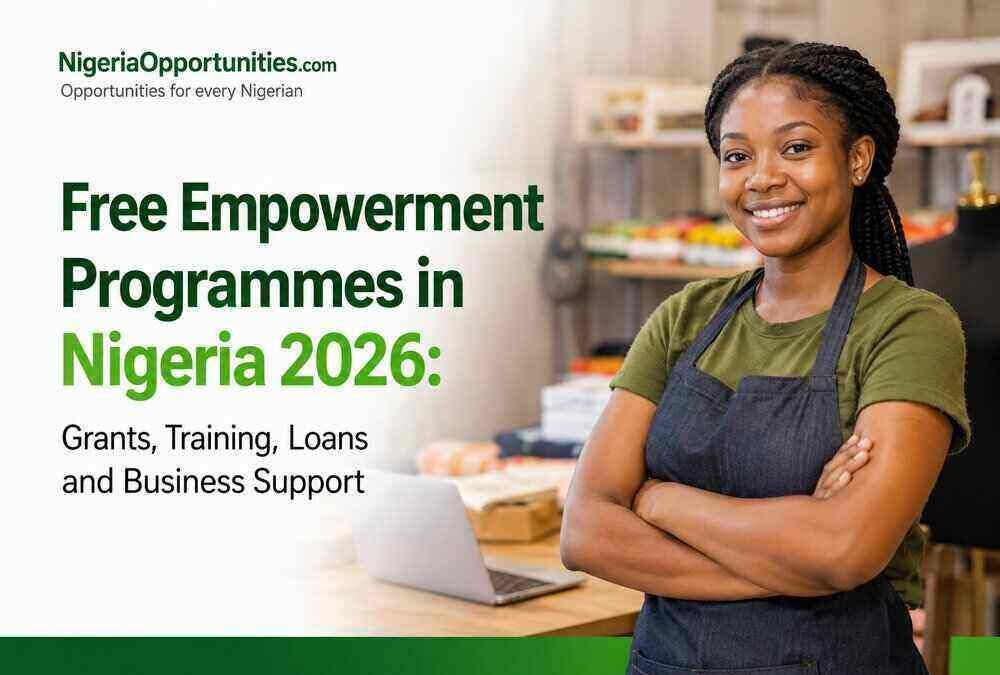
Free Empowerment Programmes in Nigeria 2026 are providing opportunities for young people, women, entrepreneurs, artisans, farmers, graduates and other Nigerians to gain skills, access business support, receive grants or connect with affordable financing.
These programmes do not all offer cash grants.
Some provide free skills training, some offer startup support or equipment, while others provide grants, low-interest loans, mentorship, business advisory services or access to markets.
There are also programmes specifically designed for women, NYSC members, rural entrepreneurs, young Nigerians and people operating small businesses.
This guide brings together the major empowerment opportunities Nigerians should know about in 2026, including programmes from the Federal Government, Bank of Industry, SMEDAN, NITDA, the National Directorate of Employment and other recognised institutions.
Important: A programme described as an empowerment opportunity is not automatically a grant. Where funding is a loan, this article clearly identifies it as a loan so applicants do not mistake repayable financing for free money.
Free Empowerment Programmes in Nigeria 2026
Some of the major empowerment programmes and initiatives to watch in 2026 include:
- SMEDAN ICSS and GROW Fund
- Bank of Industry GLOW Fund for Women
- BOI RAPID
- BOI-NYSC Entrepreneurship Programme
- Investment in Digital and Creative Enterprises (iDICE)
- 3 Million Technical Talent (3MTT)
- NDE Skills Acquisition and Employment Programmes
- Nigerian Youth Academy (NiYA)
- NiYA StartUp
- YouthCred
- NYSC SAED
- Digital Literacy for All (DL4ALL)
- WE-Elevate for Women-Led MSMEs
- Government Enterprise and Empowerment Programme (GEEP)
- N-Power
- Agri-business and youth empowerment opportunities
- Federal Government Bottom-Up Empowerment projects
- State-level empowerment programmes
The availability and application status of these programmes are not the same. Some are currently active, while others operate through periodic cohorts or government implementation windows.
1. SMEDAN ICSS and GROW Fund
The SMEDAN Inspire, Create, Start, Scale (ICSS) Programme is one of the more interesting opportunities for Nigerians who want to start or grow a business.
The programme is designed to take participants through different stages of entrepreneurship.
The four stages are:
- Inspire – for people who are yet to develop a business idea
- Create – for people with a business idea
- Start – for people preparing to launch
- Scale – for existing business owners looking to expand
The 2026 programme information published through the Federal Ministry of Youth Development’s Youth Initiative portal states that the training is available nationally and that graduates of the ICSS programme can become eligible for GROW Fund financing. Youth, women and graduates are prioritised for the financing component.
The financing listed for the programme includes:
- START: ₦250,000 to ₦2 million
- SCALE: ₦1 million to ₦5 million
The financing is described as single-digit-interest loans, meaning applicants should not treat the GROW Fund as a grant.
For a more detailed information check our guide on SMEDAN Grow Fund
Who is it for?
The programme can be useful for:
- Aspiring entrepreneurs
- Existing business owners
- Young Nigerians
- Women
- Graduates
- Small business operators
Best for: Nigerians who want business training followed by a possible route to affordable business financing.
2. BOI Guaranteed Loans for Women (GLOW)
Women entrepreneurs looking for empowerment funding should pay particular attention to the Guaranteed Loans for Women (GLOW) programme operated by the Bank of Industry.
GLOW is a ₦10 billion fund designed to improve access to finance for women-owned and women-led businesses.
The programme offers financing at a reported 7% per annum all-inclusive rate, with financing of up to ₦50 million, depending on the business and applicable lending category.
The programme is not simply about providing loans.
BOI says GLOW also includes:
- Business advisory support
- Mentorship
- Capacity building
- Enterprise development support
In January 2026, BOI announced a partnership with the National Credit Guarantee Company to provide up to ₦10 billion in guaranteed financing to eligible women-owned businesses.
The current BOI intervention-fund platform lists GLOW among its ongoing programmes accepting applications. Read ₦500,000 Business Grant for Nigerian Entrepreneurs 2026
Who can benefit?
GLOW is designed for women who own or lead businesses across eligible sectors, including areas such as:
- Manufacturing
- Processing
- ICT
- E-commerce
- Creative industries
- Healthcare
- Education
- Renewable energy
- Waste management
Best for: Women who already operate a viable business and need financing to expand.
3. BOI RAPID Programme
The Rural Area Programme on Investment for Development (RAPID) is another BOI initiative aimed at businesses operating in rural and economically underserved communities.
RAPID is particularly relevant to entrepreneurs whose businesses are connected to rural economic activity and value chains.
The programme provides:
- Business financing
- Business advisory services
- Support for rural enterprises
- Assistance for value-chain development
BOI’s intervention platform currently lists RAPID among its ongoing programmes.
The programme has supported businesses across Nigeria. BOI reported that RAPID supported 880 rural enterprises with more than ₦6.5 billion in 2025, creating thousands of direct and indirect jobs.
Who should consider RAPID?
It may be particularly relevant to:
- Rural entrepreneurs
- Agribusinesses
- Small manufacturers
- Agro-processors
- Rural service businesses
- Entrepreneurs operating in underserved communities
Best for: Businesses outside major urban centres that need finance and business support.
4. BOI-NYSC Entrepreneurship Programme
The BOI-NYSC Entrepreneurship Programme is designed to help NYSC corps members move from national service into entrepreneurship.
The Bank of Industry’s current intervention platform lists the programme as a ₦2 billion fund supporting corps members with affordable financing and capacity building.
The programme is particularly relevant because many young Nigerians complete NYSC without immediately securing permanent employment.
Rather than waiting indefinitely for a job, participants can use entrepreneurship training and access to financing to develop businesses.
Read: NYSC SAED Registration 2026: How Corps Members Can Register and Join
Who is it for?
- NYSC corps members
- Young entrepreneurs
- Corps members with viable business ideas
- Corps members interested in starting nano or micro businesses
Best for: Current corps members looking for an entrepreneurship route during or after service.
5. Investment in Digital and Creative Enterprises (iDICE)
The Investment in Digital and Creative Enterprises (iDICE) programme is designed to develop Nigeria’s technology and creative economy.
It is being implemented through the Bank of Industry with support from international development partners.
Unlike a conventional cash-grant programme, iDICE combines:
- Skills development
- Enterprise development
- Startup support
- Innovation
- Incubation
- Access to investment opportunities
The programme targets young Nigerians in the digital and creative sectors.
BOI’s 2026 documents show that digital and creative hubs are being developed in Nigerian universities and polytechnics to provide young people aged 15 to 35 with skills training, mentorship, innovation support and pathways into employment and entrepreneurship.
BOI has also reported that iDICE is targeted at more than 300,000 Nigerians, with support for founders, tech ventures and youth innovation programmes.
Areas covered can include
- Technology
- Software development
- Digital businesses
- Creative industries
- Startup development
- Innovation
Best for: Young Nigerians interested in technology, startups and the creative economy.
6. 3 Million Technical Talent (3MTT)
The 3 Million Technical Talent (3MTT) programme is one of Nigeria’s major technical-skills initiatives.
It is designed to train Nigerians in technical areas that can lead to employment, entrepreneurship and participation in the digital economy.
The programme covers areas including:
- Software development
- Data analysis
- Data science
- Cybersecurity
- Cloud computing
- UI/UX design
- DevOps
- Product management
- Quality assurance
- Animation
- Game development
- Artificial intelligence and machine learning
The Federal Government’s services portal currently describes 3MTT as being in its third cohort, with more than 1.87 million fellows registered and a 2026 budget of more than ₦10 billion. It also reports that the programme has moved into a talent-registry phase connecting trained fellows with technology opportunities.
This is not a cash empowerment programme.
Its value is in skills, talent development and access to employment opportunities.
Best for: Young Nigerians who want a technology career.
7. National Directorate of Employment (NDE) Programmes
The National Directorate of Employment (NDE) remains one of the Federal Government’s long-running institutions for unemployment reduction and skills development.
NDE operates programmes under four major areas:
- Vocational Skills Development
- Small Scale Enterprises
- Rural Employment Promotion
- Special Public Works
The agency says its programmes are designed to help unemployed Nigerians acquire skills and improve their chances of earning a livelihood.
NDE also provides skills in different trades and operates an online system through which unemployed Nigerians can create accounts and access available programmes.
The agency says it has impacted more than 3.6 million unemployed Nigerians through its interventions.
NDE’s vocational training can be particularly relevant to people interested in practical trades.
For More details check this guide NDE Skills Training 2026: Available Skills, Requirements and How to Register
Examples of areas can include:
- Tailoring
- Catering
- Welding
- Electrical work
- Hairdressing
- ICT
- Agriculture
- Auto-related skills
- Other vocational trades
The exact training available can change by location and programme cycle.
Best for: Unemployed Nigerians and people seeking practical vocational or enterprise skills.
8. Nigerian Youth Academy (NiYA)
The Nigerian Youth Academy (NiYA) provides free learning opportunities for young Nigerians.
The programme combines skills development with entrepreneurship, career development and other youth-focused opportunities.
In August 2026, the Federal Ministry of Youth Development said 239,726 young Nigerians had acquired digital, employability and other practical skills through NiYA.
NiYA is therefore relevant to young people who want to improve their employability without necessarily committing to a formal university programme.
Best for: Nigerian youths looking for free skills and career-development opportunities.
9. NiYA StartUp
For young Nigerians who already have business ideas, NiYA StartUp provides a more entrepreneurship-focused route.
The Federal Ministry of Youth Development describes NiYA StartUp as a national innovation initiative that identifies and supports young entrepreneurs.
Support can include:
- Funding
- Mentorship
- Enterprise tools
- Business development
- National visibility
The programme is based on competitive selection, meaning not every applicant automatically receives funding.
Who should consider it?
- Young entrepreneurs
- Startup founders
- Young innovators
- Nigerians developing solutions to local problems
Best for: Young people building startups or innovative businesses.
10. YouthCred
YouthCred is a Federal Government-backed credit initiative operated through the Nigerian Consumer Credit Corporation (CREDICORP).
It is important to understand that YouthCred is credit, not a grant.
The programme combines financial education with access to affordable credit.
The Ministry of Youth Development says YouthCred is targeted particularly at:
- NYSC corps members
- Employed young Nigerians
- Youth entrepreneurs
Applicants complete an online credit-education process before gaining access to eligible credit products.
YouthCred is therefore different from traditional empowerment grants.
The objective is to help young Nigerians gain access to formal credit while developing responsible borrowing habits.
Best for: Young Nigerians who need affordable credit rather than a non-repayable grant.
11. NYSC SAED Programme
The NYSC Skills Acquisition and Entrepreneurship Development (SAED) programme is another major empowerment opportunity for young Nigerians.
It is available to serving corps members and provides training in practical, vocational and entrepreneurial areas.
Training can cover areas such as:
- Agriculture
- Fashion
- Food processing
- Photography
- Solar installation
- Technology
- Beauty and personal care
- Entrepreneurship
The 2026 programme information published through the Youth Initiative portal says current mobilised corps members can participate and that SAED includes access to entrepreneurship support, mentorship and possible financing opportunities.
SAED is particularly important because it allows corps members to begin developing a second skill while completing their national service.
Best for: Serving NYSC corps members.
12. Digital Literacy for All (DL4ALL)
The Digital Literacy for All (DL4ALL) programme is another Federal Government initiative aimed at increasing digital inclusion.
It is being implemented by NITDA and covers foundational digital skills such as:
- Device use
- Information and data literacy
- Digital content creation
- Communication
- Digital safety
- Problem solving
The programme also includes an informal-sector component targeting groups such as traders, artisans, farmers, food vendors and other small business operators.
This makes DL4ALL an empowerment opportunity for people who want to use technology to improve their businesses or daily work.
Best for: Beginners, artisans, traders, farmers and other Nigerians who need practical digital skills.
13. WE-Elevate for Women-Led MSMEs
WE-Elevate is a programme designed specifically for women-led micro, small and medium-sized businesses.
The programme provides:
- Digital skills
- Financial skills
- Entrepreneurship training
- Mentorship
- E-commerce training
- Access to global e-commerce platforms
The official programme portal says it is designed to help women-led MSMEs move from offline business operations towards online and scalable businesses.
This makes it particularly useful for women who already sell products or services but want to use digital tools to reach more customers.
Best for: Women entrepreneurs and women-led MSMEs.
14. Government Enterprise and Empowerment Programme (GEEP)
The Government Enterprise and Empowerment Programme (GEEP) is one of Nigeria’s established social-investment programmes.
GEEP was created to provide access to credit for people at the lower end of the economic pyramid, including:
- Traders
- Artisans
- Farmers
- Women
- Enterprising youths
- Small business operators
- Other vulnerable entrepreneurs
The National Social Investment Programme Agency lists GEEP among the Federal Government’s major social-intervention programmes.
Its established components have included:
MarketMoni
Designed for small traders and micro-enterprises.
FarmerMoni
Focused on farmers and agricultural workers.
TraderMoni
Designed for petty traders and very small businesses.
Historically, the programme has provided small loans rather than outright grants. The NSIPA description lists loan amounts ranging from ₦50,000 to ₦300,000 under its GEEP structure.
Important 2026 note
GEEP should not be confused with a permanently open application portal.
Applicants should rely on official NSIPA announcements for the opening of a new application or disbursement cycle rather than paying anyone who claims to have guaranteed access.
15. N-Power
N-Power is another Federal Government empowerment programme aimed at helping young Nigerians acquire skills and gain work experience.
The Federal Ministry of Humanitarian Affairs and Poverty Reduction describes N-Power as a job-creation and skills-empowerment programme for young Nigerians aged 18 to 35.
The programme has historically included graduate and non-graduate pathways and has focused on:
- Skills development
- Work experience
- Employability
- Entrepreneurship
- Community service
Is N-Power currently open?
There is an important distinction here.
The government website currently carries information about N-Power and describes a new programme as coming soon, but that does not mean Nigerians should assume that a fresh application portal is currently open.
Therefore, avoid paying anyone claiming to have access to a secret N-Power registration link.
Best for: Young Nigerians when a new official recruitment or enrolment cycle is announced.
16. Agricultural Empowerment Programmes
Agriculture remains an important part of Nigeria’s empowerment strategy, particularly for young people and women.
The Federal Government’s current National Agricultural Investment Plan identifies youth and women-focused agricultural training and entrepreneurship programmes as part of efforts to create jobs along the agricultural value chain.
The strategy covers opportunities across:
- Farming
- Processing
- Logistics
- Marketing
- Agribusiness
- Agricultural technology
- Access to finance
It also identifies support for youth and women through access to land and financial services as a priority.
This means empowerment opportunities in agriculture should not be viewed only as farming grants.
A young person can potentially participate in:
- Food processing
- Livestock
- Fisheries
- Agricultural logistics
- Storage
- Packaging
- Farm input businesses
- Agricultural technology
- Produce marketing
Applicants should watch the Federal Ministry of Agriculture and relevant government agencies for specific programmes and application windows.
17. Federal Government Bottom-Up Empowerment Projects
The Federal Government’s Bottom-Up Empowerment project database contains a large number of constituency-level empowerment projects being implemented through government ministries, departments and agencies.
These are particularly interesting because they cover many different forms of support.
The official Youth Initiative database currently lists projects involving:
- Skills acquisition
- Startup grants
- Sewing machines
- Agricultural training
- Solar installation
- Fishing
- Hairdressing
- Tailoring
- Photography
- Cosmetology
- Digital skills
- Entrepreneurship training
- Equipment and machinery
Projects are spread across different states and federal constituencies.
For example, the database lists skills acquisition and startup grants for youths and women in Lagos Island, solar-panel installation training in Kano and the FCT, and entrepreneurship and agricultural empowerment projects in several states.
This is important because many Nigerians search only for nationwide grants and miss empowerment projects implemented at constituency level.
Best for: Nigerians looking for local or constituency-based empowerment opportunities.
18. Women-Focused Federal Empowerment Programmes
Women have several additional empowerment opportunities in 2026.
The Federal Government has highlighted initiatives including:
- EmpowerHer774
- Nigeria for Women Programme Scale-Up
- Women Agro-Value Expansion and Farm-to-Feed Initiative
- PowerHer774
- Women in Gas
- Women-on-Wheels Initiative
- Women-Led MSME Expansion and Access to Finance Programme
- She’s Included
The Federal Ministry of Information reported in 2026 that these initiatives form part of the government’s wider social-impact and women-economic-empowerment agenda.
One particularly notable initiative is She’s Included, which focuses on:
- Financial inclusion
- Entrepreneurship
- Digital empowerment
- Access to finance
- Women’s economic participation
The government announced in July 2026 that work was underway on the second edition of the initiative.
Women should therefore not limit their search to general business grants.
19. SMEDAN Business Empowerment Programmes
The Small and Medium Enterprises Development Agency of Nigeria (SMEDAN) operates a broad range of programmes for entrepreneurs and MSMEs.
Its current programme portfolio includes:
- GROW-Her
- Cluster Development Support
- Products and Marketing Enhancement Scheme
- AWAKE
- MSME Digital Academy
- Mind Shift Entrepreneurship Programme
- Conditional Grant Scheme for Micro Enterprises
- National Business Skills Development Initiative
- Garment and Textile Cluster Growth Support Scheme
- Agri-business Development and Empowerment Programme
- Women in Self-Employment Programme
- One Local Government One Product
- SMEDAN Select
This is one of the most useful organisations for Nigerians searching for business empowerment because its programmes cover different sectors rather than concentrating on one type of entrepreneur.
Examples include:
Women in Self-Employment Programme (WISE-P) – aimed at improving opportunities for women in self-employment.
National Business Skills Development Initiative (NBSDI) – business skills development.
Agri-business Development and Empowerment Programme (ADEP) – agricultural enterprise support.
Garment and Textile Cluster Growth Support Scheme (GCSS) – support for businesses in the garment and textile sector.
MSME Digital Academy – digital capacity development for MSMEs.
One Local Government One Product (OLOP) – development of local products and enterprise clusters.
Best for: Entrepreneurs who want business development, training, market support or access to financing opportunities.
20. YOUWIN Enterprise Education Programme
The Youth Empowerment and Innovation Programme (YOUWIN) is another government initiative focused on entrepreneurship.
In the first half of 2026, YOUWIN conducted enterprise education outreach across all 37 NYSC orientation camps covering the 36 states and the FCT.
The programme provided corps members with enterprise-development education as they prepared for life after national service.
This is an important distinction.
YOUWIN is not simply a grant website where everyone submits an application and receives money.
Its current activity includes enterprise education and entrepreneurship development, with specific programmes or funding opportunities depending on the implementation cycle.
Best for: Young Nigerians, particularly corps members and aspiring entrepreneurs.
Which Empowerment Programme Is Best for You?
There is no single programme that is suitable for everyone.
Your choice should depend on what you need.
| If you are… | Programmes to consider |
|---|---|
| A young entrepreneur | SMEDAN ICSS, NiYA StartUp, YouthCred |
| A woman business owner | GLOW, WE-Elevate, SMEDAN WISE-P |
| An NYSC corps member | SAED, BOI-NYSC, YOUWIN |
| An aspiring tech professional | 3MTT, iDICE |
| An artisan | NDE, DL4ALL, SMEDAN programmes |
| A farmer | Agricultural empowerment programmes, SMEDAN ADEP, GEEP |
| A rural entrepreneur | BOI RAPID |
| A trader | GEEP, SMEDAN programmes |
| An unemployed Nigerian | NDE, N-Power when reopened |
| A person with limited digital skills | DL4ALL |
| A startup founder | NiYA StartUp, iDICE |
| A woman seeking business finance | GLOW |
| A small business owner | SMEDAN, FGN/BOI intervention programmes |
Which Empowerment Programmes Offer Grants?
This is one of the most important questions applicants ask.
Not every empowerment programme provides a grant.
Grant or non-repayable support
Programmes may offer grants, startup support or equipment depending on the specific scheme and cohort.
Examples include:
- Selected startup competitions
- Some constituency empowerment projects
- Selected youth and women empowerment initiatives
- Some agricultural and skills programmes
- Previous Presidential Conditional Grant Scheme beneficiaries
The Presidential Conditional Grant Scheme (PCGS), for example, was specifically designed as a non-repayable grant for eligible nano businesses. BOI reported that the scheme reached hundreds of thousands of beneficiaries.
However, applicants should not assume that PCGS is currently accepting fresh applications in 2026.
Loans
The following are examples of financing that must be repaid:
- GLOW
- GROW Fund
- YouthCred
- FGN MSME Intervention Fund
- GEEP loans
- BOI RAPID
- BOI-NYSC financing
For example, the FGN/BOI MSME intervention is explicitly described as a loan, with repayment over three years and an interest rate of 9% per annum.
Is the FGN MSME Intervention Fund Still Open?
The FGN MSME Intervention Fund should be treated separately from free grants.
The official BOI portal describes it as a ₦75 billion MSME loan programme with a maximum loan amount of ₦1 million per business under the published terms.
However, the current registration page says:
“New applications to the fund are no longer being accepted.”
Therefore, it should not be presented to readers as an open 2026 application.
This is exactly why applicants should check the current status before submitting personal information or making any payment.
How to Apply for Free Empowerment Programmes in Nigeria
The application process depends on the programme.
Generally, applicants should:
1. Identify the right programme
Choose based on your age, business type, location, skills and objective.
2. Visit the official platform
Use the website of the government ministry, agency or recognised organisation operating the programme.
3. Check eligibility
Some programmes are specifically for:
- Youths
- Women
- NYSC members
- Farmers
- Artisans
- MSMEs
- Graduates
- Rural businesses
4. Prepare your documents
Depending on the programme, you may need:
- National Identification Number
- Bank Verification Number
- Valid identification
- CAC documents
- Business information
- Business plan
- Phone number
- Email address
5. Complete the application yourself
Do not give an unknown agent control of your application or personal information.
6. Keep your application details
Save your application number, email confirmation and other relevant information.
Beware of Fake Empowerment Grant Websites
The popularity of empowerment programmes has also created opportunities for scammers.
A genuine programme have:
- An official government website
- A recognized implementing agency
- Published eligibility requirements
- An official application process
- Clearly stated terms
Be suspicious when someone says:
“Pay ₦5,000 and I will secure your empowerment grant.”
or:
“Send your BVN and OTP so I can register you.”
Do not share your banking PIN, OTP or password with anyone.
Also remember that a loan application may require financial information for verification, but that does not mean an applicant should disclose their banking security credentials to an individual claiming to be an agent.
Are Empowerment Programmes Really Free?
It depends on what “free” means.
Free training: You attend the programme without paying tuition.
Grant: You receive money that does not have to be repaid, subject to the programme’s terms.
Loan: You receive financing that must be repaid.
Equipment support: You may receive tools or equipment rather than cash.
Mentorship: You receive business or career support without necessarily receiving money.
This distinction matters.
For example, GLOW is an empowerment financing programme, but it is a loan facility, while a skills programme such as NDE training can provide training without requiring participants to repay the cost of the training.
Can Students Apply for Empowerment Programmes?
Yes, although eligibility depends on the particular programme.
Students can find opportunities in:
- Digital skills
- Entrepreneurship
- Agriculture
- Technology
- Innovation
- Creative industries
- Vocational training
However, some programmes require applicants to be graduates, business owners, NYSC members or within a specific age range.
Students should therefore choose opportunities where their status matches the stated requirements.
Can Unemployed Nigerians Apply?
Yes.
Several empowerment programmes are specifically designed to help unemployed Nigerians develop skills or create sources of income.
The NDE, for example, is mandated to implement programmes aimed at combating unemployment and operates vocational skills, small enterprise and rural employment programmes.
N-Power has also historically targeted unemployed young Nigerians, although applicants should wait for an official new application announcement rather than relying on old registration links.
What Can You Receive From an Empowerment Programme?
Depending on the programme, support may include:
- Free training
- Business training
- Technical skills
- Digital skills
- Startup grants
- Business loans
- Equipment
- Tools
- Mentorship
- Business advisory
- Market access
- Incubation
- Internship or work experience
- Job placement support
- Access to investors
The amount or type of support is determined by each programme.
There is no standard “empowerment package” that every Nigerian applicant receives.
More Opportunities for Nigerians
NigeriaOpportunities.com publishes verified updates on grants, business funding, scholarships, jobs, internships, SIWES placements, student loans, skills acquisition programmes, digital training and other opportunities available to Nigerians.
If you are interested in business funding, you can also read our Business Grants for Young Entrepreneurs in Nigeria 2026 guide.
You can also explore our Youth Skills Acquisition Programmes in Nigeria 2026 article for vocational and entrepreneurship training opportunities.
For digital opportunities, see our guide to Free Digital Skills Training in Nigeria 2026.
Keep checking NigeriaOpportunities.com for new empowerment programmes, grants, training opportunities and business support schemes.
Frequently Asked Questions
What are the best free empowerment programmes in Nigeria in 2026?
Some of the major opportunities include SMEDAN programmes, NDE skills programmes, 3MTT, iDICE, NiYA, NYSC SAED, DL4ALL, GLOW, WE-Elevate and other youth, women and MSME initiatives.
Which empowerment programme gives free money?
Not every programme gives free money. Some provide grants, while others provide loans that must be repaid. Applicants should read the funding terms before applying.
Which programme is best for young entrepreneurs?
SMEDAN ICSS, NiYA StartUp, iDICE, YouthCred and relevant BOI programmes can be useful depending on whether the applicant needs training, credit, incubation or business support.
Which empowerment programme is best for women?
Women can consider GLOW, WE-Elevate, SMEDAN’s women-focused programmes and other government women-empowerment initiatives.
Can NYSC members receive empowerment support?
Yes. NYSC members have access to SAED, the BOI-NYSC Entrepreneurship Programme and other youth entrepreneurship initiatives.
Can artisans benefit from government empowerment programmes?
Yes. NDE and DL4ALL are among the programmes relevant to artisans, while SMEDAN also operates programmes targeting MSMEs and specific business sectors.
Are GLOW and YouthCred grants?
No. GLOW provides business financing that must be repaid, while YouthCred provides credit to eligible young Nigerians.
Is N-Power currently open for registration?
The official Federal Ministry page currently describes N-Power as a programme and indicates that a new programme is coming soon. Nigerians should therefore wait for an official fresh application announcement rather than relying on old registration links.
Is the FGN MSME Intervention Fund currently accepting applications?
The current BOI registration page says new applications are no longer being accepted.
How can I avoid fake empowerment programmes?
Apply through the official website of the government agency or recognised organisation responsible for the programme. Do not pay unofficial agents or share your OTP, PIN or passwords.
Important point
The phrase “empowerment programme” covers many different forms of support in Nigeria.
For one person, empowerment may mean learning a trade through NDE. For another, it could mean obtaining a business loan through BOI, receiving startup support through a youth programme, learning a technical skill through 3MTT, or getting business training through SMEDAN.
The most important thing is to choose an opportunity that matches your situation.
Young entrepreneurs can explore SMEDAN, NiYA StartUp, iDICE and BOI programmes.
Women entrepreneurs have opportunities such as GLOW, WE-Elevate and SMEDAN’s women-focused initiatives.
NYSC members can consider SAED and BOI-NYSC.
Artisans and unemployed Nigerians should pay attention to NDE and DL4ALL.
Rural entrepreneurs can look at BOI RAPID and agricultural programmes.
And Nigerians interested in technology can consider 3MTT and iDICE.
Most importantly, do not assume that every empowerment programme offers a grant. Some provide training, some provide equipment, and some provide loans with interest and colleteral that must be repaid.
Always confirm the current application status and terms from the official programme before submitting your information.