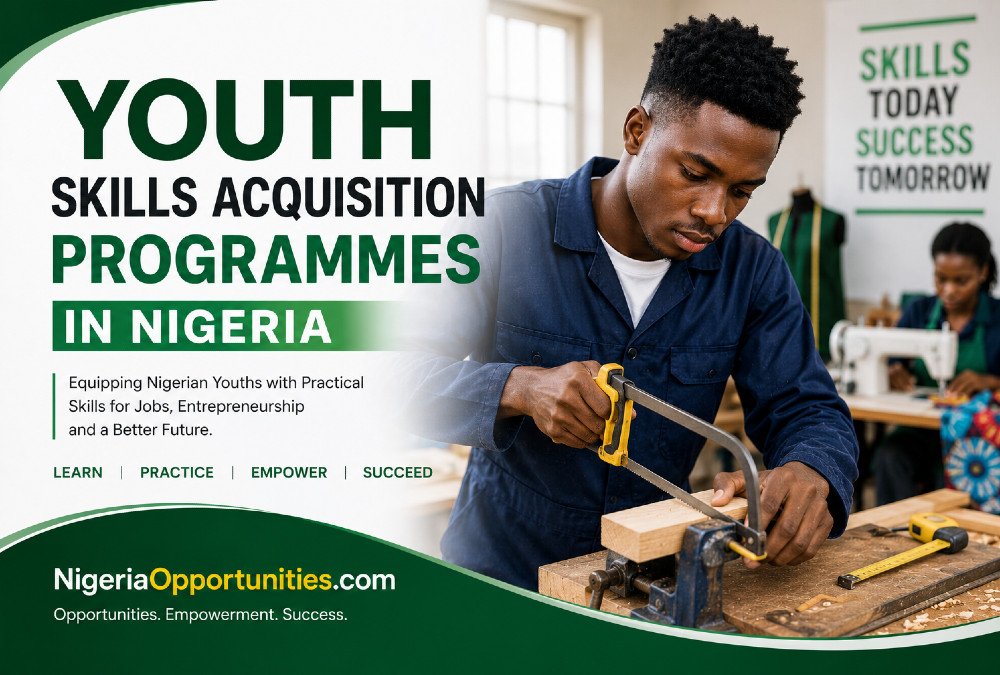
Youth Skills Acquisition Programmes in Nigeria 2026 are giving young Nigerians different routes into vocational trades, technology, entrepreneurship and self-employment.
For someone who is unemployed, recently out of school or looking for a practical skill to build a career around, there is no need to depend on one programme alone. The Federal Government and its agencies run different initiatives, but they are designed for different groups.
For example, an unemployed Nigerian looking to learn a trade may find the National Directorate of Employment (NDE) more suitable, while an existing artisan can look at Skill-Up Artisans (SUPA). A serving corps member has access to NYSC SAED, while someone interested in technology can consider 3MTT.
This guide explains the major opportunities, who they are meant for, the skills involved and what to consider before applying.
Best Youth Skills Acquisition Programmes in Nigeria 2026
Some of the major programmes Nigerian youths should know about include:
- NDE Vocational Skills Development Programme
- Skill-Up Artisans (SUPA) Programme
- NYSC Skills Acquisition and Entrepreneurship Development (SAED)
- 3 Million Technical Talent (3MTT)
- State government skills acquisition programmes
- Other government-backed vocational and entrepreneurship initiatives announced during the year
These programmes should not be treated as interchangeable. Their target groups, training methods and objectives are different.
| Programme | Mainly suitable for | Main focus |
|---|---|---|
| NDE Skills Training | Unemployed Nigerians | Vocational and technical skills |
| SUPA | Intending and skilled artisans | Artisan training, upgrading and certification |
| NYSC SAED | NYSC corps members | Skills and entrepreneurship |
| 3MTT | Nigerians interested in technology | Digital and technical skills |
| State programmes | Residents of individual states | Vocational skills and entrepreneurship |
NDE Skills Acquisition Programme
The National Directorate of Employment (NDE) is one of the main Federal Government agencies responsible for tackling unemployment through employment-related training and skills acquisition.
Its programmes include Vocational Skills Development (VSD), which provides training opportunities for unemployed Nigerians.
NDE’s official website lists numerous trades, including fashion designing, computer operation, auto mechanics, electrical installation, welding, plumbing, furniture making, catering, GSM repairs, refrigeration and air-conditioning repairs, photography, shoe making and several others.
This makes NDE particularly relevant to young Nigerians who want to learn a practical trade that can eventually be turned into a source of income.
The agency also runs other employment-related interventions, so NDE should not be viewed simply as a place to learn one particular trade. Its broader mandate is to create employment opportunities and address unemployment in Nigeria.
Best suited for: Unemployed Nigerians, school leavers, graduates and people interested in vocational or technical skills.
For the full details, see our NDE Skills Training 2026 guide.
Skill-Up Artisans SUPA Programme
The Skill-Up Artisans (SUPA) Programme is different from a basic beginner skills programme.
It is an initiative of the Industrial Training Fund (ITF) aimed at improving the capacity of artisans through training, certification, licensing and other forms of support.
The official SUPA platform currently provides separate registration options for Intending Artisans, Skilled Artisans and Training Centres.
This is important because it means someone who has never learnt a trade can follow the intending-artisan route, while an experienced artisan can register as a skilled artisan.
SUPA’s stated objectives include identifying and categorising artisans, providing Industry 4.0-compliant training, promoting health and safety, helping artisans access tools and equipment, supporting certification and licensing, and improving employment opportunities.
The programme covers trades such as carpentry, masonry, plumbing and electrical work, among others.
Best suited for: Intending artisans and people who already work in a skilled trade.
Read our detailed Skill-Up Artisans SUPA Programme 2026 guide for eligibility, training and programme benefits.
NYSC SAED Programme
For Nigerian graduates currently undergoing the National Youth Service Corps programme, NYSC SAED is one of the most relevant skills opportunities available.
The Skills Acquisition and Entrepreneurship Development (SAED) programme is designed to expose corps members to vocational skills while developing their entrepreneurial abilities.
NYSC says the programme involves skills acquisition, entrepreneurship development and collaboration with training organisations and financial institutions.
Training areas have included agro-allied activities, food processing, culture and tourism, cosmetology, ICT, construction, environment, power and energy and other sectors.
The advantage for corps members is that they can begin developing a practical skill during their service year instead of waiting until after NYSC before thinking about self-employment.
Best suited for: Serving NYSC corps members.
If you are a corps member, see our guide to NYSC SAED Programme 2026.
3 Million Technical Talent Programme
The 3 Million Technical Talent (3MTT) programme is one of the major government initiatives for Nigerians interested in digital and technical careers.
Unlike NDE’s traditional vocational trades, 3MTT focuses on developing technical talent for the digital economy.
The programme’s listed areas include:
- Artificial intelligence and machine learning
- Animation
- Cloud computing
- UI/UX design
- Data analysis and visualisation
- Data science
- DevOps
- Game development
- Product management
- Quality assurance
- Software development
- Cybersecurity
The official 3MTT website describes the programme as a major component of Nigeria’s effort to build its technical talent base.
The programme uses a combination of online and physical learning. Its first phase, for example, combined self-paced online courses with applied learning sessions through training partners.
3MTT also has a placement component. Its official Placement Hub connects trained fellows with opportunities including internships, full-time technology jobs and freelance microjobs.
The programme’s current partner information reports more than 160,000 fellows trained across three cohorts, with fellows represented across all 36 states and the FCT.
Best suited for: Nigerians who want to build careers in technology and digital work.
You can visit the official 3MTT website for the latest programme information.
State Government Skills Acquisition Programmes
Federal Government programmes are not the only opportunities available.
State governments across Nigeria also introduce skills acquisition, entrepreneurship and empowerment programmes for young residents.
The training offered can include:
- Fashion designing
- Catering
- Hairdressing
- Barbing
- Welding
- Carpentry
- Electrical installation
- Plumbing
- Agriculture
- Food processing
- ICT
- Soap production
- Beauty services
- Other locally relevant trades
The major difference is that these programmes are usually tied to a particular state.
A training opportunity announced by the Lagos State Government, for example, should not automatically be presented as a nationwide Federal Government programme.
Young Nigerians should therefore pay attention to the state, target beneficiaries, application period and sponsoring agency before applying.
What Skills Can Young Nigerians Learn?
The choice is much wider than traditional vocational trades.
Vocational and Artisan Skills
Young people interested in hands-on work can consider:
- Fashion designing
- Tailoring
- Plumbing
- Electrical installation
- Welding and fabrication
- Carpentry
- Furniture making
- Auto repairs
- Refrigeration and air-conditioning
- Catering
- Barbing
- Hairdressing
- Shoe making
- Leather work
- Painting
- Masonry
NDE’s current skills list includes many of these areas.
Digital and Technology Skills
Technology provides another path.
Depending on the programme, young Nigerians can develop skills in:
- Software development
- Data analysis
- Data science
- Cybersecurity
- Artificial intelligence
- Cloud computing
- UI/UX design
- DevOps
- Product management
- Quality assurance
3MTT is particularly relevant to this category.
Entrepreneurship Skills
Technical ability alone does not automatically produce a successful business.
Young people who want to become self-employed also need to understand areas such as:
- Customer service
- Pricing
- Record keeping
- Marketing
- Business planning
- Digital marketing
- Financial management
- Finding and retaining customers
This is why programmes that combine technical training with entrepreneurship can be particularly useful.
Which Skills Acquisition Programme Is Right for You?
There is no single programme that is best for every Nigerian.
Your current situation should determine where you start.
If you have never learnt a trade: Look at beginner-friendly vocational programmes, including relevant NDE opportunities.
If you already work as an artisan: SUPA may be more appropriate because it provides routes for both intending and skilled artisans.
If you are currently serving in NYSC: SAED gives you an opportunity to acquire vocational and entrepreneurship skills during your service year.
If you want a technology career: 3MTT is one of the major government-backed options to consider.
If you want to start a local service business: A practical trade such as plumbing, electrical work, catering, fashion or furniture making may be more useful than choosing a course simply because it is popular.
The important question is not only “Which programme can I join?”
It is also “What do I want to do with this skill after the training?”
Do These Programmes Give Participants Money?
This is one of the most important things applicants should understand.
Skills training, grants, loans and allowances are not the same thing.
A programme can provide free training without giving participants cash.
Another programme may offer equipment, certification, mentorship or access to funding opportunities without handing every participant a cash grant.
For example, NDE’s mandate centres on employment creation and skills development, while SUPA lists training, certification, licensing, tools, equipment and access to funds among its objectives.
That does not mean every person who registers will automatically receive money or equipment.
Applicants should therefore read the actual benefits attached to the specific programme rather than relying on social media posts promising “free government money”.
What Do You Need Before Applying?
There is no single application requirement for every youth skills programme.
The documents and information requested depend on the programme.
You may need some combination of:
- National Identification Number (NIN)
- Phone number
- Email address
- Passport photograph
- Date of birth
- State and local government information
- Educational details
- Information about your existing trade or skills
- Identification documents
For example, the current SUPA registration platform requests an 11-digit NIN, phone number, email address, personal details and a passport photograph. It also states that applicants must be 18 or older.
This does not mean every programme has exactly the same requirements.
How to Avoid Fake Skills Acquisition Programmes
The popularity of government empowerment programmes has also created opportunities for fraudsters.
Before submitting your personal information, check:
Who is running the programme?
There should be a named government agency, ministry or recognised organisation behind it.
What is the official website?
Do not assume that a website is genuine simply because its page contains government logos.
Is registration actually open?
An old registration page from 2024 or 2025 does not automatically mean that a new 2026 application exercise is underway.
Are they asking you to pay?
Be careful when someone on WhatsApp or Facebook asks for money to “secure a slot” in a government programme.
The official SUPA terms, for example, state that the platform is currently provided free of charge and that payments should not be made to ITF officials or agents for artisan registration or services.
What Happens After Skills Training?
Completing a course is not the end of the process.
The real value of a skill comes from what you do with it afterwards.
A trained electrician can begin taking private jobs. A fashion designer can build a customer base. A software developer can create projects for a portfolio. A trained artisan can pursue certification and improve the standard of their services.
Some programmes also provide pathways beyond training.
3MTT, for example, has a placement system connecting trained talent with internships, full-time jobs and freelance opportunities.
SUPA’s stated objectives include certification, licensing and improved employment opportunities for artisans.
This is why young Nigerians should look beyond the certificate and consider the employment or business opportunities that the skill can create.
Can Graduates Apply for Skills Acquisition Programmes?
Yes, depending on the programme.
A university degree does not prevent someone from learning a practical or technical skill.
A graduate can learn programming, data analysis, fashion designing, electrical installation, catering, photography, agriculture or another commercially useful skill.
However, eligibility differs.
A programme designed specifically for corps members will not be open to every graduate, while a programme for artisans may require existing trade experience.
Always match the programme to your current status before applying.
Are Skills Acquisition Programmes Free?
Many government-backed programmes provide training at no cost to selected participants, but there is no universal rule covering every programme.
The specific programme should always be checked for its current terms.
For example, the official 3MTT website stated that there was no commitment fee for its first phase. SUPA currently describes its account setup as free and says the platform is free to join.
This is also why applicants should avoid paying unofficial agents.
More Opportunities for Nigerians
NigeriaOpportunities.com publishes updates on government skills training, scholarships, internships, SIWES placements, jobs, grants, student loans, business funding and other opportunities available to Nigerians.
If you are looking for more training options, you can also explore our Free Skills Acquisition Programmes in Nigeria guide, which covers additional opportunities for Nigerians who want to learn practical and digital skills.
You can also see our guides on NDE Skills Training 2026 and the Skill-Up Artisans SUPA Programme 2026 for more detailed information about specific programmes.
Keep checking NigeriaOpportunities.com for new government programmes, skills acquisition opportunities and other verified opportunities.
Frequently Asked Questions
What are the best youth skills acquisition programmes in Nigeria in 2026?
Some of the major programmes to consider are NDE vocational training, SUPA, NYSC SAED and 3MTT. State governments also run their own skills programmes.
Which programme is best for learning a trade?
NDE is one of the major options for Nigerians looking for vocational and technical training. Its listed trades include areas such as fashion designing, plumbing, welding, electrical installation, furniture making, catering and auto mechanics.
Which programme is suitable for an existing artisan?
SUPA is particularly relevant because its official platform has separate registration routes for skilled artisans and intending artisans.
Which government skills programme is available to NYSC members?
NYSC SAED is specifically designed to provide corps members with skills acquisition and entrepreneurship development opportunities.
Which programme should I choose if I want to learn technology?
3MTT is one of the Federal Government’s major technical talent initiatives, with areas including software development, cybersecurity, data science, AI/machine learning, cloud computing and UI/UX.
Do skills acquisition programmes give cash?
Not automatically. Training, grants, loans and allowances are separate forms of support. The actual benefits depend on the programme.
Can unemployed graduates apply for skills training?
Yes, where the programme’s eligibility requirements allow graduates to participate. However, some programmes are restricted to particular groups such as artisans or NYSC corps members.
Summary
Youth skills acquisition programmes can give Nigerians another route into work at a time when many young people are competing for a limited number of formal jobs.
The right choice depends on where you are starting from.
Someone who wants to learn a trade can explore NDE opportunities. An existing artisan can consider SUPA. A corps member can take advantage of SAED, while someone interested in building a technology career can look towards 3MTT.
The most important thing is to choose a skill with a clear use after training and to apply through the appropriate official channel.
NigeriaOpportunities.com will continue to track new skills acquisition, training, employment and empowerment opportunities as they are announced.