CDCFIB oral interview questions are now a major concern for candidates who have been shortlisted after successfully completed the physical and medical screening stages of the 2024/2025 recruitment exercise.
The Civil Defence, Correctional, Fire and Immigration Services Board (CDCFIB) has moved the recruitment exercise to the final oral interview stage and has released a fresh notice dated 28 August 2026 outlining when shortlisted candidates should check for their interview details. Check Your Name HERE
Candidates who applied under the Graduate Category are required to log into the official recruitment portal from Monday, 31 August to Wednesday, 2 September 2026 to find out if they have been shortlisted for the oral interview.
Those who applied with NCE, OND or SSCE qualifications are expected to check the portal from Monday, 7 September to Wednesday, 9 September 2026.
Shortlisted candidates will be required to select an available interview venue, date and time through the recruitment portal and print their invitation letters.
The Board has also made it clear that candidates should follow the dress code stated on their invitation letters.
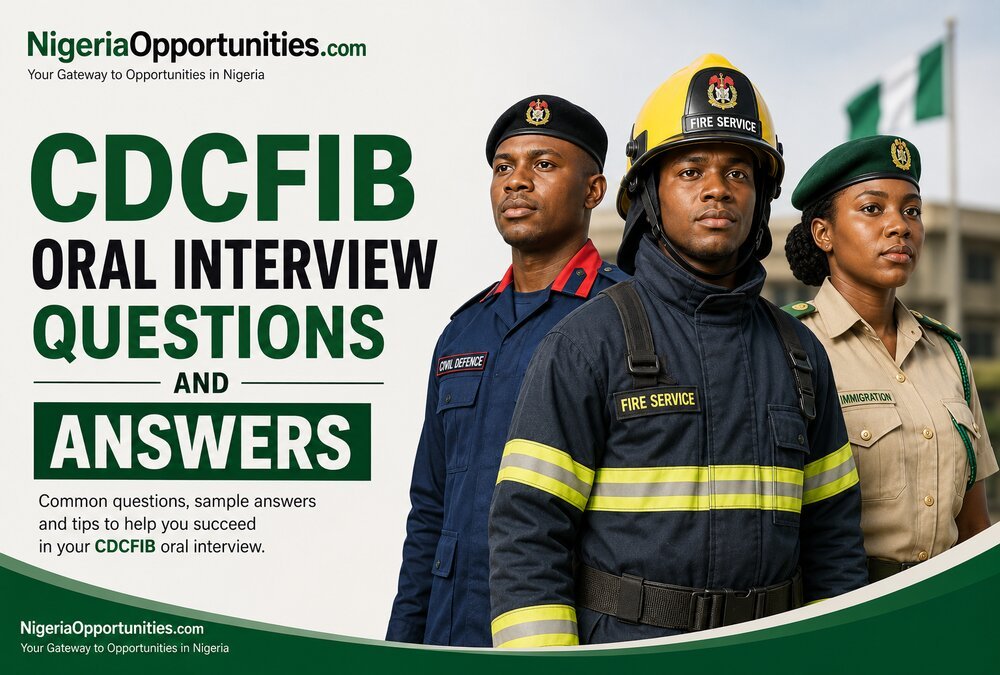
This article provides possible CDCFIB oral interview questions and answers candidates can use for preparation, covering the four services under the Board, general questions, current affairs and situations involving discipline and integrity.
What is CDCFIB Oral Interview?
The oral interview is the latest stage of the recruitment process for candidates who successfully completed the earlier physical and medical screening.
CDCFIB oversees recruitment into four paramilitary organizations:
- Nigeria Security and Civil Defence Corps (NSCDC)
- Nigeria Correctional Service (NCoS)
- Federal Fire Service (FFS)
- Nigeria Immigration Service (NIS)
Candidates should therefore prepare according to the particular service they applied for.
Someone applying to the Nigeria Immigration Service, for example, should know the basic responsibilities of the NIS. An applicant for the Federal Fire Service should be familiar with fire prevention and emergency response.
The panel may also ask general questions about the candidate’s background, motivation, national issues, discipline and ability to work under pressure.
There is no official list of questions that CDCFIB has announced will be asked at the oral interview. The questions below are therefore possible interview questions for revision purposes.
Possible CDCFIB Oral Interview Questions and Suggested Answers
The questions below cover areas candidates are likely to need for the CDCFIB oral interview, including the Board, the four services, basic national issues and professional conduct. They are practice questions, not questions officially released by CDCFIB.
General Questions for All Candidates
1. Please introduce yourself.
Suggested answer:
Good morning Sir/Ma. My name is ________. I am from ________ Local Government Area in ________ State. I attended ________ and obtained my ________ qualification from ________. I applied for the ________ Service because I am interested in serving Nigeria and contributing positively to the work of the organization.
Keep your introduction short. The panel does not need your entire personal history.
2. Why do you want to join the service?
Suggested answer:
I want to serve my country and build a career based on discipline, integrity and responsibility. I am interested in the work of the ________ Service and believe my skills, education and willingness to learn will enable me to contribute effectively.
Candidates should replace the blank with the particular service they applied for.
3. What does CDCFIB mean?
Answer:
CDCFIB means Civil Defence, Correctional, Fire and Immigration Services Board.
The Board is responsible for matters relating to the four services under it, including recruitment, promotion and discipline.
4. Name the four agencies under CDCFIB.
Answer:
The four agencies are:
- Nigeria Security and Civil Defence Corps (NSCDC)
- Nigeria Correctional Service (NCoS)
- Federal Fire Service (FFS)
- Nigeria Immigration Service (NIS)
5. What would you do if someone asked you to pay money to secure your recruitment?
Answer:
I would not make the payment. I would report the person through the appropriate channel because CDCFIB has stated that the recruitment exercise is free of charge.
6. Are you willing to work in another part of Nigeria?
Suggested answer:
Yes Sir/Ma. I am ready to serve wherever I am posted and will carry out my duties responsibly.
Questions for Nigeria Immigration Service Candidates
Candidates who applied for the Nigeria Immigration Service (NIS) should pay particular attention to questions about immigration control, passports, border management and the responsibilities of the Service.
7. What is the mandate of the Nigeria Immigration Service?
Answer:
The Nigeria Immigration Service is responsible for areas including the control of people entering and leaving Nigeria, immigration administration, passport-related services and border management.
8. What is the motto of the Nigeria Immigration Service?
Answer:
People First.
9. Can you mention types of Nigerian passports?
Answer:
Examples include:
- Standard/ordinary passport
- Official passport
- Diplomatic passport
- Pilgrim passport
- Seaman’s passport
Candidates should make sure they are familiar with the current categories used by the Service.
10. Why is border control important?
Answer:
Border control helps Nigeria regulate the movement of people into and out of the country, strengthen national security and support the lawful movement of travelers.
11. What would you do if you discovered that a traveler was using a suspicious document?
Suggested answer:
I would remain professional, follow the established procedure and report the matter to the appropriate superior or authority for further investigation.
Questions for NSCDC Candidates
Those who applied to the Nigeria Security and Civil Defence Corps (NSCDC) should understand the Corps’ role in protecting lives, infrastructure and national assets.
12. What is the mandate of the NSCDC?
Answer:
The NSCDC has responsibilities that include the protection of critical national assets and infrastructure, disaster management and other civil-defence and security duties assigned to the Corps.
13. What are critical national assets and infrastructure?
Answer:
They are facilities and infrastructure considered important to the functioning, security and economy of the country.
Examples include:
- Oil and gas pipelines
- Power infrastructure
- Railway infrastructure
- Telecommunications infrastructure
- Other strategically important public facilities
14. Why is protecting critical national infrastructure important?
Answer:
Damage, vandalism or disruption of critical infrastructure can affect security, businesses, public services and the wider economy. Protecting such assets therefore helps keep essential services running and safeguards national interests.
15. What is the motto of the NSCDC?
Answer:
Protecting the Nation and its Critical Assets.
Questions for Federal Fire Service Candidates
Applicants to the Federal Fire Service (FFS) should revise fire prevention, emergency response, rescue operations and basic fire safety.
16. What are the classes of fire?
Answer:
The commonly taught classes include:
- Class A: Ordinary combustible materials such as wood, paper and cloth
- Class B: Flammable liquids
- Class C: Flammable gases
- Class D: Combustible metals
- Class E: Electrical fires
- Class F: Cooking oils and fats
Candidates should note that fire classifications can differ between standards and jurisdictions, so they should follow the classification taught in the official recruitment or training material where applicable.
17. What should you do when you discover a fire?
Answer:
Raise the alarm, alert people nearby, contact the emergency services and evacuate people from danger. A person should only attempt to extinguish a small fire if it is safe to do so and they know how to use the appropriate extinguisher.
18. What is the motto of the Federal Fire Service?
Answer:
Fire Prevention is Better than Fire Fighting.
19. Why is fire prevention important?
Answer:
Preventing a fire before it starts reduces the risk of loss of life, property damage and disruption to businesses and communities.
Questions for Nigeria Correctional Service Candidates
Candidates for the Nigeria Correctional Service (NCoS) should understand the Service’s responsibilities in custodial management, rehabilitation and reintegration.
20. What is the mandate of the Nigeria Correctional Service?
Answer:
The Nigeria Correctional Service is responsible for the safe custody, rehabilitation and reintegration of persons committed to its care.
21. What is the motto of the Nigeria Correctional Service?
Answer:
Reforming Inmates, Transforming Lives.
22. What is the purpose of rehabilitation in the correctional system?
Answer:
Rehabilitation helps inmates develop the skills, attitudes and behaviour needed to return to society and live productive lives after completing their sentences.
23. Mention two non-custodial measures.
Answer:
Two examples are probation and community service.
Other non-custodial measures may also apply under Nigeria’s correctional laws and procedures.
24. Why is discipline important to a correctional officer?
Answer:
Correctional officers work in an environment where security, order and professionalism are essential. Discipline helps an officer follow lawful procedures, maintain control and perform duties responsibly.
Current Affairs and National Issues
The panel may also move away from service-specific questions and ask candidates basic questions about Nigeria.
25. What are the three arms of government?
Answer:
The three arms are:
- Executive
- Legislature
- Judiciary
26. What is the capital of Nigeria?
Answer:
Abuja.
27. How many states are in Nigeria?
Answer:
Nigeria has 36 states, in addition to the Federal Capital Territory, Abuja.
28. What is the role of the Executive?
Answer:
The Executive is responsible for implementing and enforcing laws and managing the day-to-day administration of government.
29. What is the role of the Legislature?
Answer:
The Legislature makes laws, represents citizens and performs oversight functions over the Executive.
30. What is the role of the Judiciary?
Answer:
The Judiciary interprets the law and settles legal disputes in accordance with the Constitution and applicable laws.
Ethics and Situational Questions
Some questions may not require a memorised factual answer. Instead, the panel may give you a situation and ask what you would do.
31. What would you do if your colleague asked you to hide an official mistake?
Suggested answer:
I would not participate in concealing the mistake. I would encourage the colleague to report it through the proper channel and, where necessary, report the matter to the appropriate superior.
32. What would you do if someone offered you a bribe?
Suggested answer:
I would refuse the bribe and report the incident through the appropriate official channel.
33. What would you do if you disagreed with your superior?
Suggested answer:
I would remain respectful, seek clarification and follow the appropriate chain of command. If the matter involved an unlawful instruction, I would use the proper reporting procedure.
34. Can you work under pressure?
Suggested answer:
Yes Sir/Ma. I understand that the work may involve demanding situations. I would remain calm, follow instructions and procedures, prioritize my responsibilities and work with my colleagues to handle the situation effectively.
35. What does integrity mean to you?
Suggested answer: Integrity means doing what is right, being honest and maintaining professional standards even when nobody is watching.
Do Not Memorise the Answers Word for Word
Candidates should use these questions to guide their preparation rather than memorising every answer exactly as written.
The panel may ask a follow-up question immediately after your response.
For instance, if you say you want to join the Nigeria Immigration Service because of its role in national security, the panel may ask you to explain what the NIS does.
You should therefore understand the subject instead of memorising a paragraph.
Your answer to “Tell us about yourself” should also be based on your real qualifications and information contained in your application.
Prepare for Questions About Your Application
Candidates should go through the information they submitted during the recruitment process before appearing before the panel.
Be familiar with your:
- Full name
- State of origin
- Local government area
- Date of birth
- Educational qualifications
- Institution attended
- Course of study
- Work experience
- Professional qualifications
- Service selected during application
If the panel asks about your course of study, you should be able to discuss basic areas related to it.
You should also avoid giving information that contradicts what you submitted during the recruitment exercise.
What to Take to the CDCFIB Interview
Shortlisted candidates should carefully read their invitation letters because the Board has instructed candidates to follow the requirements contained in those letters.
The invitation will provide important information about the venue, date, time and dress code.
Candidates should print the invitation letter and organize the required documents before the interview day.
Keep your original certificates and any requested photocopies together in a clean folder.
Do not leave document preparation until the morning of the interview.
Read Also : Required Document and Dress code
CDCFIB Interview Venue, Date and Shortlist Update
The latest CDCFIB notice requires Graduate Category applicants to check the recruitment portal between 31 August and 2 September 2026.
Applicants who used NCE, OND or SSCE qualifications are to check between 7 and 9 September 2026.
Shortlisted candidates will then select an available venue, date and time through the portal and print their invitation letters.
The Board has also stated that it will not send emails concerning this stage of the recruitment exercise.
Candidates should therefore be careful with messages, links and claims circulating on WhatsApp, Facebook and other social media platforms.
The recruitment exercise remains free of charge.
Candidates should use the official CDCFIB recruitment portal for their interview status and invitation details.
Official CDCFIB Recruitment Portal: https://recruitment.cdcfib.gov.ng/
More Recruitment Opportunities
NigeriaOpportunities.com publishes recruitment updates, government jobs, interview guides, scholarships, internships, skills training programmes and other opportunities for Nigerians.
Keep checking NigeriaOpportunities.com for new recruitment announcements, application updates and useful guides for job seekers.