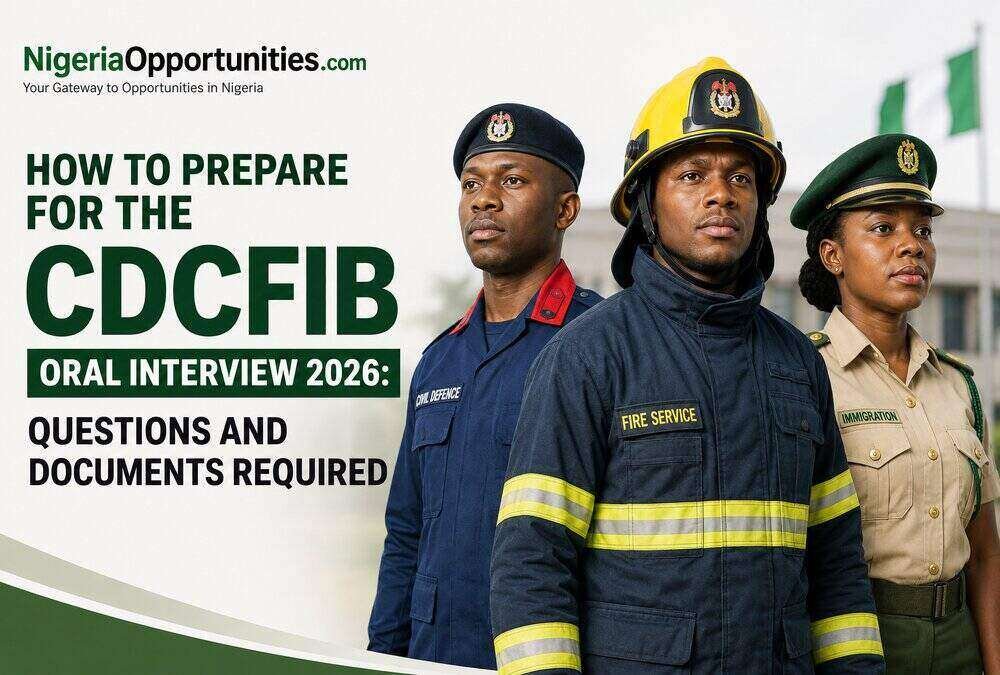
How to Prepare for the CDCFIB Oral Interview is now an important concern for candidates who have progressed through the physical and medical screening stage of the ongoing Civil Defence, Correctional, Fire and Immigration Services Board recruitment.
The Board has concluded its assessment and shortlisting process and has directed successful candidates to check the recruitment portal for their oral interview invitation. Check Your Name HERE
According to the latest announcement, candidates under the Graduate Category are to check the portal from August 31 to September 2, 2026, while applicants who used NCE, OND or SSCE qualifications are expected to check from September 7 to September 9, 2026. Shortlisted candidates will then select an interview venue, date and time and print their invitation letters.
The recruitment exercise covers four paramilitary services: the Nigeria Security and Civil Defence Corps (NSCDC), Nigeria Immigration Service (NIS), Nigeria Correctional Service (NCoS) and Federal Fire Service (FFS).
With the oral interview being the next major stage for successful candidates, preparation should start now rather than after receiving an invitation.
What the CDCFIB Oral Interview Is About
The oral interview is different from the CBT.
The CBT tested candidates’ ability to answer written questions under time pressure. The oral interview gives the panel an opportunity to assess how candidates communicate, how well they understand the service they applied for and how they respond to questions.
Candidates should be ready to speak about their:
- Educational background
- Chosen paramilitary service
- Understanding of the job
- Motivation for joining
- Knowledge of national issues
- Ability to work with others
- Discipline and sense of responsibility
- Response to difficult situations
There is no need to memorize long speeches.
A candidate who understands the organization, knows the responsibilities attached to the position and can communicate clearly will be in a better position than someone who simply memorizes answers from an interview guide.
Start With the Service You Applied For
One of the first things to revise is the organization you selected during the recruitment exercise.
The four services have different responsibilities.
Nigeria Security and Civil Defence Corps
Candidates who applied to the NSCDC should understand the Corps’ responsibilities in civil defence, protection of critical national assets and infrastructure, public safety, disaster management and other security-related duties assigned to it.
You should be able to explain why you want to work with the NSCDC and what you understand about the responsibilities of an officer.
Do not give a generic answer that could apply equally to the Fire Service or Immigration Service.
Nigeria Immigration Service
Candidates for the NIS should revise areas connected with immigration and border management.
Pay attention to:
- Immigration control
- Border security
- Passports
- Migration management
- Entry and exit procedures
- Combating irregular migration
- The role of immigration officers
You should also know why you chose the Immigration Service and how its work contributes to national security.
Federal Fire Service
Those applying to the Federal Fire Service should understand the work involved in:
- Fire prevention
- Firefighting
- Rescue operations
- Emergency response
- Public fire-safety awareness
- Disaster response
The panel may want to know whether you understand that the job involves responding to emergencies and protecting lives and property.
Nigeria Correctional Service
Candidates for the Nigeria Correctional Service should revise the responsibilities of the Service in relation to custodial centres, inmate welfare, rehabilitation and reintegration.
You should understand that correctional work is not simply about keeping people in custody. Rehabilitation and preparing inmates for successful reintegration into society are also important aspects of the correctional system.
CDCFIB Oral Interview Questions to Practice
There is no confirmed official list of questions that every candidate will be asked.
However, candidates can prepare for questions around their background, the organization they applied to, public service and general knowledge.
Tell us about yourself.
Keep your response brief.
Mention your name, educational background, relevant experience or skills and your reason for being interested in the position.
Do not spend several minutes discussing unrelated personal information.
Why do you want to join this service?
This question gives you an opportunity to show that you understand what you applied for.
Your answer should go beyond saying that you need a job.
Explain your interest in public service and the contribution you believe you can make.
What do you know about CDCFIB?
You should know what Civil Defence, Correctional, Fire and Immigration Services Board means and the four services under its recruitment responsibility.
Be careful not to describe CDCFIB as though it is one of the four operational services.
Why did you choose this particular service?
Your answer should connect your interest, skills or background with the service you selected.
A candidate who applied for Immigration should have a different reason from someone who applied for Fire Service.
What are the major duties of the service you applied for?
This is one question you should prepare thoroughly.
Know the actual responsibilities of your service rather than relying on a general statement about “protecting Nigeria”.
What does discipline mean to you?
A strong answer should demonstrate respect for lawful authority, regulations, professional conduct and responsibility.
How would you handle pressure at work?
Give a practical answer.
You can explain how you prioritize tasks, remain calm and seek assistance where necessary instead of allowing pressure to affect your judgement.
What would you do if a superior gave you an unlawful instruction?
Do not say that you would blindly obey every instruction.
Your response should demonstrate respect for the chain of command while recognizing the importance of lawful conduct and the appropriate reporting procedure.
What would you do if someone offered you money to overlook an offence?
The appropriate response should demonstrate integrity.
A candidate should make it clear that bribery is unacceptable and that such conduct should be handled through the proper reporting channels.
Why should we select you?
Use this opportunity to bring together your strongest qualities.
Mention qualities that are relevant to the job, such as discipline, teamwork, reliability, willingness to learn and the ability to work under pressure.
Avoid claiming that you are better than every other candidate.
Revise Questions About Your Own Application
Do not prepare only general questions.
Go through the information you supplied when applying.
You should remember:
- The service you selected
- The cadre you applied for
- Your educational qualification
- Your course of study
- Your institution
- Your state of origin
- Your local government area
- Your date of birth
- Relevant work experience
- Professional qualifications
- Skills included in your application
The panel may ask questions that appear simple but are intended to establish whether you are familiar with the information in your application.
If your application says you studied Accounting, for example, be prepared to answer a basic question related to Accounting.
A candidate who cannot explain his or her own qualification may create unnecessary doubts during the interview.
Current Affairs Candidates Should Revise
Do not try to memorise every news story published in Nigeria.
Concentrate on important national information.
Revise:
- Current President of Nigeria
- Vice President
- Current Minister of Interior
- Leadership of the four services
- Major national security issues
- Nigeria’s neighboring countries
- Important government institutions
- Major national policies
- Recent developments involving your chosen service
- Important international organizations
- Basic facts about Nigeria
Also check for recent developments involving CDCFIB itself.
This is particularly important because recruitment information has changed quickly during the current exercise.
How to Handle a Question You Do Not Know
Do not panic if the panel asks something you cannot answer.
Do not start guessing simply because you feel pressured to respond.
You can politely say:
“Sir/Ma, I am sorry, I do not know the answer to that question.”
If you know part of the answer, give the part you are confident about.
The aim is to demonstrate honesty and composure rather than pretending to know everything.
Documents to Prepare Before the Interview
The Board has stated that shortlisted candidates will be required to print their invitation letters and appear at the selected venue according to the specified instructions and dress code.
It is therefore sensible to have your important documents organized before your interview date.
Keep your:
- Invitation letter
- Educational certificates
- Identification documents
- Relevant professional certificates
- Other documents requested by CDCFIB
in a clean folder.
Make sure the names and dates on your documents are consistent.
Do not wait until the morning of the interview to start looking for important certificates.
The earlier physical screening stage involved document verification and physical assessment, with the Board stating that uploaded credentials would be checked.
What to Wear to the CDCFIB Oral Interview
For Men
- Wear a clean, well-ironed shirt with formal trousers.
- A plain white, light blue or other neutral-coloured shirt is a safe choice.
- Wear black or brown formal shoes and clean socks.
- A simple tie is recommended if you have one.
- Make sure your hair is neat and your beard is properly groomed.
- Avoid jeans, T-shirts, trainers, slippers and flashy accessories.
For Women
- Wear a neat blouse or formal shirt with a skirt or trousers.
- A modest, well-fitted dress can also work.
- Choose neutral or calm colours rather than very bright patterns.
- Wear closed-toe shoes or other simple formal footwear.
- Keep jewellery and makeup simple.
- Avoid revealing, overly tight or very flashy clothing.
Avoid clothing that is:
- Dirty
- Excessively casual
- Distracting
- Too revealing
- Poorly fitted
Your appearance should show that you understand the seriousness of the recruitment exercise.
What to Do When You Enter the Interview Room
- Your conduct can affect the impression you make.
- When you are called in: Greet the panel politely.
- Wait to be invited to sit before taking your seat.
- Sit upright and maintain reasonable eye contact with the person asking the questions.
- Listen to the entire question before answering.
- If you do not hear a question clearly, politely ask the interviewer to repeat it.
- Do not interrupt members of the panel.
- You also do not need to force yourself to speak with a foreign accent. Clear English, confidence and respectful communication are more important.
Mistakes That Can Work Against a Candidate
- Some candidates focus so heavily on getting the answers right that they overlook their behavior.
- Avoid arguing with the interview panel.
- Avoid speaking negatively about the service you applied to.
- Do not exaggerate your qualifications or work experience.
- Do not provide information that contradicts your application.
- Do not insult or mock another candidate.
- Do not attempt to influence officials through personal connections.
- And do not pay anyone who claims to have the power to secure your place in the recruitment exercise.
- CDCFIB has repeatedly stated that the recruitment exercise is free of charge and warned applicants against individuals demanding money.
How to Get Ready for Your CDCFIB Interview
- Instead of trying to study everything at once, divide your preparation.
- Start by revising the responsibilities of your chosen service.
- Next, go through your application and educational background.
- Then revise important Nigerian current affairs and recent developments involving the service.
- After that, practice answering questions aloud.
- This is important because reading an answer silently is not the same as answering a panel verbally.
- Ask a friend or family member to conduct a short mock interview.
- Let the person ask unexpected follow-up questions rather than reading questions from a list.
- This will help you practice thinking before answering.
What Happens After the Oral Interview?
The oral interview is part of the recruitment process and should not be treated as an automatic appointment.
The latest CDCFIB announcement describes the oral interview as the final exercise for candidates who have progressed through the earlier assessment and screening stages. Only candidates shortlisted for this stage will be granted access to the interview venue.
Candidates should continue to monitor their recruitment status and follow any subsequent instructions issued through the official portal.
The Board has also stated that it will not send emails regarding this stage, so candidates should not rely on messages circulating through WhatsApp, Facebook or other unofficial platforms.
Official CDCFIB recruitment portal: recruitment.cdcfib.gov.ng
More Recruitment Opportunities
NigeriaOpportunities.com publishes recruitment updates, government jobs, interview guides, scholarships, internships, skills training programmes and other opportunities for Nigerians.
Keep checking NigeriaOpportunities.com for fresh recruitment announcements and updates from government agencies.