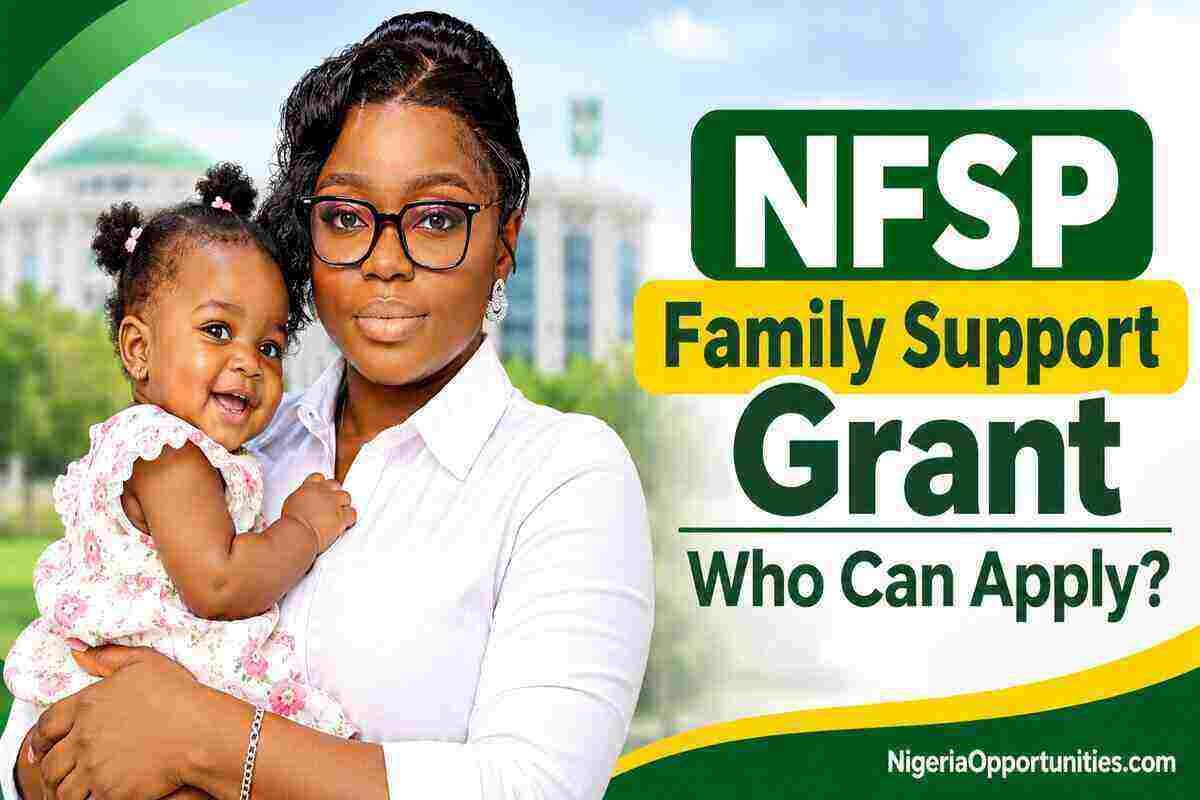
Are you wondering whether you qualify for the NFSP ₦100,000 family support grant? The Nigeria Family Strengthening and Development Programme (NFSP) lists specific conditions applicants must meet before they can be considered for the financial assistance.
The basic eligibility conditions include Nigerian citizenship, a valid National Identification Number (NIN), and an age range of 18 to 65 years. However, eligibility goes beyond these three requirements. The grant is intended to support poor and vulnerable households, so an applicant’s family and financial circumstances may also determine whether they are selected.
This guide explains who can apply, the age limit, NIN requirements, whether unemployed Nigerians qualify, and what applicants should understand about the selection process.
Who Is Eligible for the NFSP ₦100,000 Grant?
The NFSP registration information lists the following basic eligibility conditions:
- Applicants must be Nigerian citizens by birth.
- Applicants must be between 18 and 65 years old at the time of registration.
- Applicants must have a valid National Identification Number (NIN).
- Applicants must provide accurate personal, family, and employment information.
- Applicants should demonstrate an interest in contributing to Nigeria’s socioeconomic development.
- Applicants must fall within the household poverty and vulnerability categories considered for the intervention.
APPLY HERE : FG ₦100,000 NFSP Grant 2026: Registration Portal, Requirements and How to Apply
The program is intended to provide financial support to households experiencing economic difficulties. Therefore, meeting the citizenship, age, and identification requirements does not automatically qualify someone for the ₦100,000 payment.
Beneficiary selection also involves identity verification and an assessment of household circumstances.
1. Nigerian Citizenship Requirement
The first basic condition is Nigerian citizenship.
Applicants are expected to be Nigerian citizens by birth. This means the grant is intended for Nigerians who meet the citizenship condition, rather than foreign nationals living or working in the country.
During registration, applicants may be required to provide personal information and a valid NIN to support identity verification.
2. NFSP Age Limit: How Old Must Applicants Be?
The stated age requirement for the NFSP grant is 18 to 65 years.
You must be at least 18 years old and not older than 65 at the time of registration.
Here is a simple breakdown:
- Below 18 years: Not eligible under the stated age requirement.
- 18 to 65 years: Within the stated age range.
- Above 65 years: Outside the stated age range.
For example, a 25-year-old applicant meets the age condition, just as a 60-year-old applicant does. However, both must also satisfy the other eligibility requirements and pass the selection process.
3. Is NIN Compulsory for the NFSP Grant?
Yes. A valid National Identification Number is one of the stated requirements for the NFSP application.
Applicants are expected to provide their NIN for identity verification. The registration information indicates that NIN details will be checked through the National Identity Management Commission (NIMC).
Before providing your details, make sure:
- Your NIN is valid.
- Your name and other personal information are accurate.
- The information you enter matches your identification records.
- You do not provide another person’s NIN.
An incorrect or unverifiable NIN may affect an application because identity verification is part of the eligibility process.
4. Can Unemployed Nigerians Apply for the NFSP Grant?
Unemployed Nigerians may fall within the type of household the intervention is intended to support.
The program focuses on poor and vulnerable households, and employment information is part of the details applicants are expected to provide. Unemployment alone is not listed as a reason for disqualification.
However, being unemployed does not automatically guarantee selection.
Applicants may still need to meet the citizenship, age, and NIN requirements. Their household circumstances and financial vulnerability may also be considered during beneficiary assessment.
If you are unemployed, provide accurate information about your current employment status and household income. Do not invent employment details or provide false financial information to improve your chances.
5. Can Employed Nigerians Apply?
Having a job does not automatically mean you are excluded.
The important consideration is whether your household meets the financial vulnerability conditions used for beneficiary selection. A person may be employed but still struggle to support a family because of low income, household size, or other financial responsibilities.
The program’s registration process requests employment and family information, which may help assess an applicant’s circumstances.
Applicants should provide their actual employment status and income details rather than assuming that only unemployed people can qualify.
6. Are Low-Income Families Eligible for the NFSP Grant?
Low-income and financially vulnerable households are the main target of the intervention.
The program is intended to help families facing economic pressure, including difficulty meeting basic household needs.
Factors that may be relevant during household assessment include:
- Household income.
- Number of people living in the household.
- Employment and income situation.
- Financial responsibilities.
- General household vulnerability.
These factors help explain why the grant is not simply an open payment to everyone who completes an application.
A person may meet the basic age and identification requirements but still not be selected if their household does not meet the relevant vulnerability criteria.
7. Does Meeting the NFSP Requirements Guarantee ₦100,000?
No. Meeting the basic eligibility conditions does not guarantee that an applicant will receive the grant.
There are two important stages to understand:
Basic eligibility: This covers the initial conditions, such as citizenship, age, and possession of a valid NIN.
Beneficiary selection: This involves identity verification and assessment of household poverty and vulnerability. Only applicants selected through this process will qualify for payment.
The selection process is also expected to take place in phases across the six geopolitical zones. This means applicants may not all receive notifications or payments at the same time.
8. What Can Disqualify an NFSP Applicant?
Although a complete list of disqualification rules has not been established, certain issues could affect an application.
These include:
- Being younger than 18 or older than 65.
- Not meeting the stated Nigerian citizenship requirement.
- Providing an invalid or unverifiable NIN.
- Submitting incorrect or inconsistent personal information.
- Providing false household or employment details.
- Not meeting the poverty and vulnerability criteria used for beneficiary selection.
Applicants should take care when completing any registration form and ensure that all information is accurate.
9. How to Know If You Meet the NFSP Eligibility Requirements
Before considering an application, check whether you meet the basic conditions:
- You are a Nigerian citizen by birth.
- You are between 18 and 65 years old.
- You have a valid NIN.
- You can provide accurate personal and household information.
- Your household falls within the low-income or vulnerability group the intervention intends to support.
Meeting these conditions means you may fall within the stated eligibility category. It does not mean you have been approved or selected for payment.
Frequently Asked Questions About NFSP Eligibility
1. Can I apply for the NFSP grant if I live with my parents?
Living with your parents does not automatically determine whether you qualify. What matters is how the program assesses your household circumstances and financial situation. The available information does not clearly explain how applicants in shared households will be assessed.
2. Can I apply if I have previously received another government grant?
There is no clearly established rule stating that receiving another government grant automatically disqualifies someone from NFSP. However, applicants should provide accurate information about any existing financial support they receive.
3. Can I apply for the NFSP grant if I own a small business?
Owning a small business does not automatically exclude you. A small business owner may still experience financial hardship or have a low household income. Your overall financial circumstances may be considered during the assessment.
4. Will applicants be selected from every state in Nigeria?
The program’s stated coverage includes Nigeria’s six geopolitical zones. However, a confirmed state-by-state beneficiary allocation has not been established.
5. Can I change my information after submitting the application?
The available registration information does not clearly explain whether applicants can edit submitted forms. It is therefore important to review your details carefully before submission.
6. What happens if my application is not selected?
Registration does not guarantee selection. If you are not selected, you should not assume that your application is still awaiting payment or that another person can secure a place for you in exchange for money. No confirmed process for appealing an unsuccessful application has been established.
7. Is there a limit to the number of beneficiaries from one family?
The available information does not clearly state whether more than one adult from the same household can receive the grant. Applicants should not assume that each eligible family member will receive a separate ₦100,000 payment.
The NFSP ₦100,000 grant is intended to support poor and vulnerable households, not everyone who completes an online application. The stated basic conditions are Nigerian citizenship by birth, a valid NIN, and an age range of 18 to 65 years.
Unemployed and low-income Nigerians may fall within the target group, but beneficiary selection also depends on household assessment and verification.
Before submitting your NIN or other sensitive information, remember that the grant’s official government authorization and the registration platform’s status have not been independently established.